Stereochemistry and Bonding in Main Group Compounds
Lesson Structure VSEPR Theory dπ–pπ Bonds Bent Rule and Energetic of Hybridization Problems CLICK HERE TO DOWNLOAD PDF


Lesson Structure VSEPR Theory dπ–pπ Bonds Bent Rule and Energetic of Hybridization Problems CLICK HERE TO DOWNLOAD PDF
Lesson Structure Brief Resume of Concept of Laws of Thermodynamics Free Energy Chemical Potential and Entropies Partial Molar Properties Partial Molar Free Energy Partial Molar Volume and Partial Molar Heat Content and Their Significances Determinations of These Quantities Concept of Fugacity and Determinations of These Quantities Concept of Fugacity and Determination of Fugacity Non-Ideal Systems: [...]
Lesson Structure PART 1: STRUCTURE AND REACTIVITY 1.1 Objectives 1.2 Introduction 1.3 Types of reactions 1.4 Kinetics of reactions 1.5 Thermodynamics of the reactions 1.6 Hammon’d postulates 1.7 Curtin –Hammond principle 1.8 Reaction co-ordinate 1.9 Potential energy diagram 1.10 Transition states and intermediates 1.11 Methods of determining mechanisms 1.12 Isotope effect 1.13 Summary 1.14 Terminal [...]
Lesson Structure 1.1 Introduction 1.2 Classical theory of Raman effect 1.3 Quantum theory of Raman effect 1.4 Pure Rotational Raman spectra 1.5 Vibrational Raman spectra. 1.6 Vibrational - Rotational Raman spectra 1.7 Selection Rules in Raman spectroscopy 1.8 Mutual Exclusion Principle 1.9 Complementary nature of Raman and IR spectra 1.10 Structure determination from Raman and [...]
Lesson Structure 1.1 Objectives 1.2 Introduction 1.3 Delocalized chemical bonding 1.4 Conjugation and Cross-conjugation 1.5 Resonance 1.6 Hyperconjugation 1.7 Tautomerism 1.8 Hückel’s rules and Aromaticity 1.9 Anti-aromaticity 1.10 Homoaromaticity 1.11 Benzenoid and non-benzenoid aromatic compounds 1.12 Alteranant and non-alteranant hydrocarbon 1.13 Annulenes 1.14 Addition compounds 1.14.1 Crown ether complexes 1.14.2 Cryptands 1.14.3 Inclusion compounds 1.14.4 [...]
Lesson Structure Quantum Chemistry Introduction to Exact Quantum Mechanical Result The Schrodinger equation and the postulates of quantum mechanics Discussion of solution of the Schrodinger equation to some model system viz... Particle in Box The Harmonic Oscillator The rigid rotor The Hydrogen atom Approximate Methods The variation theorem Linear variation principle Perturbation theory (first order [...]
Lesson Structure Angular Momentum Ordinary angular momentum Generalized angular momentum Eigen function for angular momentum Eigen values of angular momentum Operator using ladder operators Addition of angular momentum Spin anti-symmetry Pauli exclusion principle Electronic Structure of Atoms Electronic configuration Russell-Saunders terms and coupling schemes Stater-Condon Parameters Term Separation Energies of the pn configuration Term Separation [...]
Lesson Structure 1 Introduction 2 Microstates, macrostates, ensembles 3 Mathematical basics: probability theory 4 The microcanonical ensemble 5 The Boltzmann entropy and Boltzmann distribution 6 The canonical ensemble 7 Thermodynamic state functions 8 Crystals 9 Fermi-Dirac, Bose-Einstein, and Maxwell-Boltzmann statistics 10 Ideal mono-atomic gas 11 Ideal gas with internal degrees of freedom 12 Mixtures of [...]
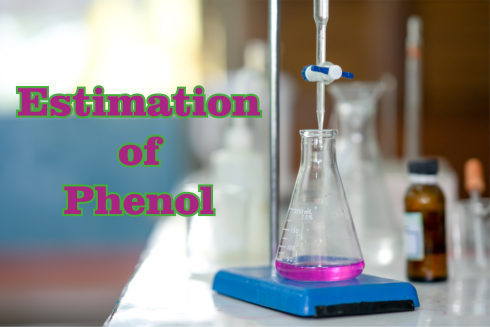
Aim: Estimation of phenol compound by brominating method. Required: 0.1 N Na2S2O3.5H2O solution, 0.1 N Brominating solution, 10% KI solution, con. HCl Procedure: Take 25 ml of given Phenol solution and dilute it up to 250 mL using distilled water in 250 mL conical flask take 10 mL of diluted solution in a stoppered bottle [...]