
Aim: Preparation of Dibenzal acetone from Benzaldehyde.
Requirements:
- Benzaldehyde = 5.0 mL (5.23 g.)
- 10% aqueous sodium hydroxide solution = 40.0 mL
- Acetone = 2.0 mL
- Rectified Spirit = 20.0 mL
Procedure:
- Dissolve benzaldehyde and pure acetone in a 20.0 mL rectified sprit in 250 mL conical flask
- Prepare 40.0 mL 10% sodium hydroxide solution
- Add this alkali solution drop-wise to the former solution over a period of 30 minutes. Shake the mixture vigorously in the tightly crocked flask for about 10 minutes with releasing the pressure from time to time if necessary. Then allow to stand for 30 minutes with occasional shaking.
- Finally cool in ice water for a few minutes. During the shaking the “Dibenzal-Acetone” separates first as a fine emulsion which than rapidly forms pale yellow crystals. Filter at the pump wash well with water to eliminate traces of alkali check with litmus paper to the filtrate till red litmus become unchanged.
- Recrystallized from hot methylated spirit. The dibenzal acetone is obtained as pale yellow crystals. The purified dibenzal acetone melts at 122° C.
Results:
- Theoretical Yield: ______________g.
- Practical Yield: ________________g.
- % yield of the product: _____________%.
- P of dibenzal acetone: ___________°C
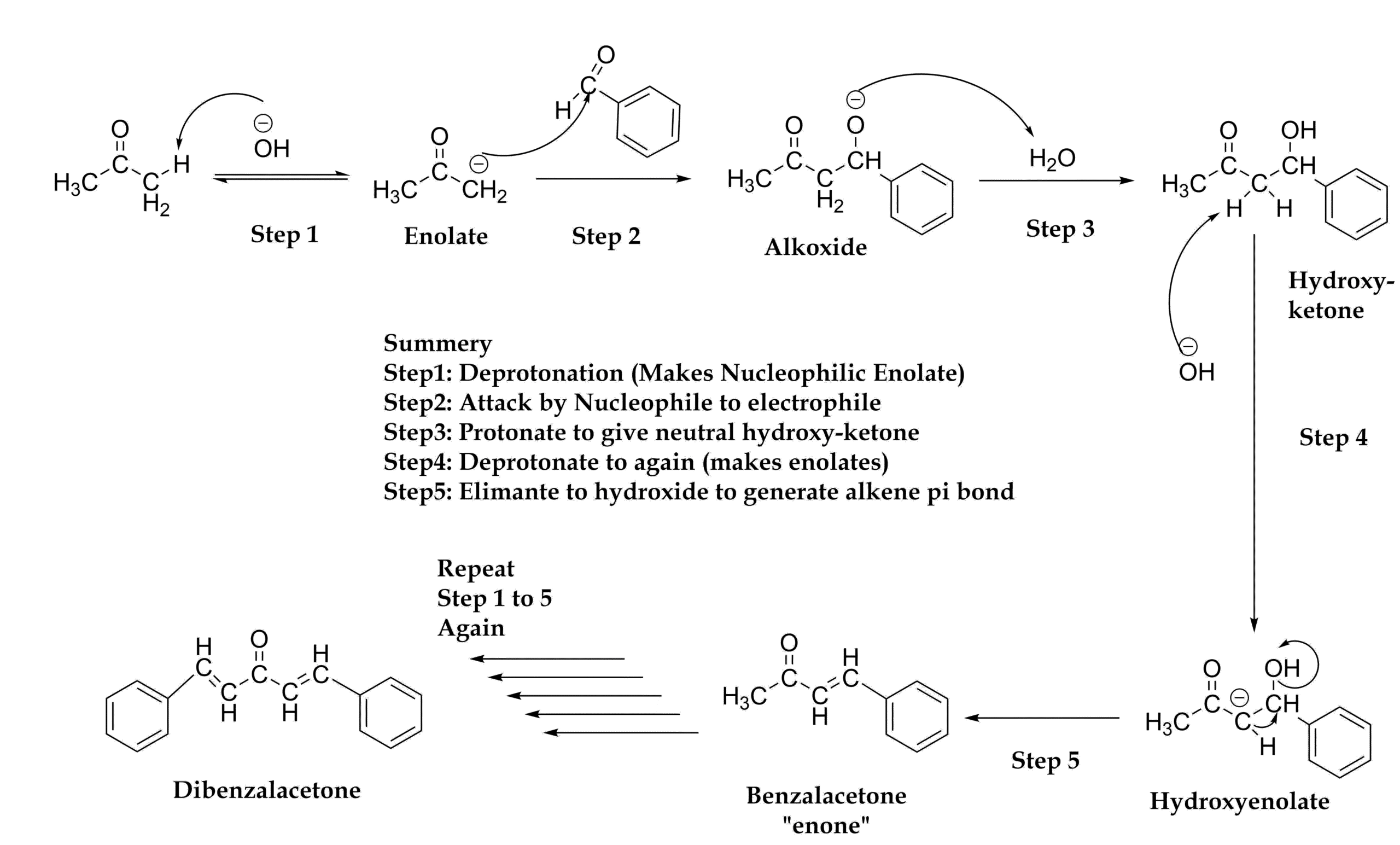
Chemical Reaction:

Mechanism:
Calculation:
- Theoretical Yield
Benzaldehyde: C7H6O (106 g.) Density = 1.046 g/mL Dibenzal acetone: C17H14O (234 g.)
From Chemical Reaction
212 g. Benzaldehyde = 234 g. Dibenzal acetone
∴ 5.23 g. Benzaldehyde = (?) g. Dibenzal acetone
= \frac{5.23\times 234.0}{212.0}
= 5.77 g.
- Practical Yield :
Actual weight of the dried product = ________________g.
- % of Yield = \frac{Practical Yield\times 100}{Theoretical Yield}
= _______________%
Leave A Comment